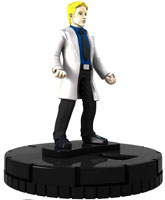
One of the best peripheral items to get for HeroClix, if you play in tournaments with any regularity, has always been a product called ID-Rings. The old versions were colored rubber rings that wrapped around the outside of either cup or inverted Clix base. Most players used these rings to differentiate there figures from there of their opponents, although some used them to signify which figures had certain Feats, but when that mechanic was in fashion as well.
The old rings always had the problem that they didn't work on figures with larger bases, but since those at the time were mostly rare in appearance anyway, that really wasn't such a big deal. Fast forward to the age of the Oreo Base and all of a sudden the old ID Rings really don't work on any new figures at all.
That's where hair10 stepped in with a fantastic idea, and a desire to own a couple of 3D printers. Thanks to this idea, and the existence of a little site known as Kickstarter, Karl had the idea, and the means to see it come to fruition, and flourish it did! The Kickstarter did so well in fact that there were a number of Stretch Goals introduced and reached.
I'm proud to say that I was a backer of this project (at the $25 level), and to my excitement, when I got home last night, my box of Rings were sitting on my kitchen table waiting for me! So what did my investment earn me? I received 15 Oreo Base Rings, 2 Peanut Base Rings, 1 Single-Dial Colossal Ring, and 1 Light and 1 Heavy 3D (sort of) Standard Objects.
All the items are a sturdy plastic, and the rings fit very nicely on the bases they were designed for. They slide on and off easily, but fit snuggly enough, that I'm not afraid I'm going to loose them. They're also designed to be seen, but still fit fairly well inside the squares on the map. After all these are supposed to be visual aids, not obstructions. And although they aren't a perfect match for my old ID Rings, the color is close enough considering the difference in material and design.
I think my only complaint (if you can even call it that) is that I'd like to have at least one more of each of the larger base sizes. After all I need 3 Peanut Base Rings to run the Horsemen of Apocalypse, and who wants to run only 1 Frost Giant and/or Sentinel? Hopefully once Karl gets through all of his Kickstarter rewards, there will be a chance to order these items from him in a more a la carte fashion.
Tuesday, November 6, 2012
Thursday, October 18, 2012
Mechanically Inclined: Hank Pym
As promised in my previous Mechanically Inclined article, this article is focusing on the Mechanics utilized by the very inventive, Hank Pym. That said, this article will be slightly different in focus to the last, because it will focus one how best to utilize these mechanics with Chaos War's various Dr. Pyms exclusively.
To begin, we have to look at the Ant-Man and Wasp duo figure. Why start there you ask? Because the Ant-Man and Wasp duo figure is 168 points while the combined cost of Hank and Janet only comes to 157 points. So, if we want to be able to utilize the duo, we need to start there. Now the down side to starting with the duo is that the duo is actually quite good in it's own right, so you may be tempted to stay in that form for the entirety of the game. However, for the sake of argument (and this article) you could give the duo a power action to Split into Hank and Janet at the beginning of the game (a tactic that I've employed to much success).
For the Split, Janet is the easy choice because she only has one version at 77 points. Hank on the other hand gives you up to 5 choices if you're fortunate enough to own the Con Exclusive Giant Man/Ant-Man (which I am). Personally, I either like to start with Hank Pym or the Con Exclusive Ant-Man, although regular set Ant-Man is not sloutch either. Hank gives you up front Outwit and his Tinkerer Supreme ability. However, Ant-Man gives you Stealth and Incapacitate. Fun Fact with Ant-Man: he can use Close Combat Incapacitate (because it does 'no damage') and Morph into another form.
Another thing to remember about Hank is that he can always grant you Outwit if he's in the right form. Hank has Outwit on the odd number clicks, the regular set Ant-Man has Outwit on the even number clicks. Outside of that, the most important thing to remember if you started with the Ant-Man and Wasp duo, you want to keep Hank and Janet next to each other as much as possible. This should be relatively easy, since Janet can carry Hank if they're both tiny, and she can hitch a ride on Hank if he's not.
If one of them gets injured, and you can get them both clear, you can always Merge them back together. This tactic is especially fun if they're based by an opponent that can be Poisoned. Not only that, but they have a fair amount of Exploit Weakness, which can also be surprising for an unsuspecting opponent.
The last two items that I'll touch on with Dr. Pym are his Pym Particle traits. Now if it wasn't fun enough to have Hank pay size-yo-yo during the game, he can also bring an Avenger friend along for the resize ride. Granted they have to be 75 points or less, but there's still a lot of fun to be had with other Avengers in that point range. One very important thing to remember is that this ability only works once per game and only works for as long as you have that version of Hank on the board. Be selective when you invoke this ability and make sure you plan to stay on that version long enough to make the choice worth your while. Otherwise, save it for when you can really use it. One of my favorite uses for Shrink is a Tiny Tigra.
Whatever flavor of Hank is your favorite, one thing is for sure, he's a fantastic Swiss Army Knife of abilities, and his ability to Morph is well applied. I really like every version available depending on the circumstances involved. I hope you enjoyed this installment of Mechanically Inclined. For the next article I think I'll review what I'm going to call the "Wound/Repair" mechanic that appears on Adam Warlock/Magus and Sentry/Void. As always, suggestions are welcome.
To begin, we have to look at the Ant-Man and Wasp duo figure. Why start there you ask? Because the Ant-Man and Wasp duo figure is 168 points while the combined cost of Hank and Janet only comes to 157 points. So, if we want to be able to utilize the duo, we need to start there. Now the down side to starting with the duo is that the duo is actually quite good in it's own right, so you may be tempted to stay in that form for the entirety of the game. However, for the sake of argument (and this article) you could give the duo a power action to Split into Hank and Janet at the beginning of the game (a tactic that I've employed to much success).
For the Split, Janet is the easy choice because she only has one version at 77 points. Hank on the other hand gives you up to 5 choices if you're fortunate enough to own the Con Exclusive Giant Man/Ant-Man (which I am). Personally, I either like to start with Hank Pym or the Con Exclusive Ant-Man, although regular set Ant-Man is not sloutch either. Hank gives you up front Outwit and his Tinkerer Supreme ability. However, Ant-Man gives you Stealth and Incapacitate. Fun Fact with Ant-Man: he can use Close Combat Incapacitate (because it does 'no damage') and Morph into another form.Another thing to remember about Hank is that he can always grant you Outwit if he's in the right form. Hank has Outwit on the odd number clicks, the regular set Ant-Man has Outwit on the even number clicks. Outside of that, the most important thing to remember if you started with the Ant-Man and Wasp duo, you want to keep Hank and Janet next to each other as much as possible. This should be relatively easy, since Janet can carry Hank if they're both tiny, and she can hitch a ride on Hank if he's not.
If one of them gets injured, and you can get them both clear, you can always Merge them back together. This tactic is especially fun if they're based by an opponent that can be Poisoned. Not only that, but they have a fair amount of Exploit Weakness, which can also be surprising for an unsuspecting opponent.The last two items that I'll touch on with Dr. Pym are his Pym Particle traits. Now if it wasn't fun enough to have Hank pay size-yo-yo during the game, he can also bring an Avenger friend along for the resize ride. Granted they have to be 75 points or less, but there's still a lot of fun to be had with other Avengers in that point range. One very important thing to remember is that this ability only works once per game and only works for as long as you have that version of Hank on the board. Be selective when you invoke this ability and make sure you plan to stay on that version long enough to make the choice worth your while. Otherwise, save it for when you can really use it. One of my favorite uses for Shrink is a Tiny Tigra.
Whatever flavor of Hank is your favorite, one thing is for sure, he's a fantastic Swiss Army Knife of abilities, and his ability to Morph is well applied. I really like every version available depending on the circumstances involved. I hope you enjoyed this installment of Mechanically Inclined. For the next article I think I'll review what I'm going to call the "Wound/Repair" mechanic that appears on Adam Warlock/Magus and Sentry/Void. As always, suggestions are welcome.
Thursday, October 11, 2012
Mechanically Inclined: 10th Anniversary: Battlefield Promotion
Some players in the HeroClix community scoff at the deluge of new HeroClix mechanics that seem to appear from set to set. However, any player that has any experience with collectible games knows that new mechanics are the life-blood of keeping the property fresh and vibrant. That said, not every new mechanic is going to become the "new hotness" and not every mechanic is going to play they way that WizKids expects. I plan to use my Mechanically Inclined articles to break down what works and what doesn't, and hopefully give you some tips on how to make it work better.
With that, I turn my eyes to the 10th Anniversary: Battlefield Promotion mechanic. Conceptually, I love this mechanic, even if there are some weird promotions, I think it's a pretty neat idea, and like what WizKids tried to do. However, in trying to make it work, it's really hard to execute. Let me start by setting the stage. As I've mentioned before, my oldest daughter, who's about to turn 6, has started playing HeroClix with me. We don't play with theme rules, and I have yet to introduce Special Object, but we play with darn near everything else.
The other day we were playing a 300 point game, and she had White Queen and Marvel Girl on her team (among others) and I had Batman, Robin, Wonder Woman, and Green Lantern (Alan Scott) on my team, so we had a lot of promotible figures on the map. We do not play with a timer, so we just go until one team is KO'd. In that time, you would think that at least one figure would successfully promote, right? Wrong!
Over the entirety of the game, the most tokens any one figure earned was 4, if I remember correctly. Alan Scott gained his forth on the final attack of the game that finally KO'd White Queen. After the action resolved, I did actually roll and get the 4 I needed, but the game was already over. In a timed game, I honestly don't know how you'd have the opportunity to take enough actions to make this mechanic work. I had 3 out of 4 figures with Willpower and I still couldn't get one to promote. Granted Batman was one hit KO'd by a Mind Controlled Wonder Woman early on in the game, but Robin and Green Lantern were not hurting for targets, and they hit most of the time.
So, what are my tips for making this mechanic work for you?
- Do not try to play with more than one or two of these figures on a given team. If you really want to make this mechanic work for you, you need to be able to focus on the character that you're trying to promote.
- Employ a method to get this character more opportunities to attack. Whether you employ Leadership, play a promotible character that has built in Willpower, or select a more indirect means like using Telekinesis, Edward Nigma, or Aragorn (for his free move ability), use something that can help you get the characters more chances to attack.
- Insure your ability to hit the target. Sure, the most common way to do this is with Probability Control, but I like Perplex and/or abilities like Hydra/PD to increase the characters overall attack number. The less you need to rely on the dice the better. During a game you also may want to consider not using this character to target the primary threat on the other team as well. If you want to rack up promotion tokens, go for the easier-to-hit high profile target first, if one is available to you.
Ultimately, my best tip here is, if you really want the promoted version of the figure, just leave the points for that figure on your team. However, if you'd rather play the promotible figure anyway, and just want the opportunity to have an extra goal in the game, these characters are a lot of fun, with a fun little bonus if you can pull it off.
I still really like the idea of this mechanic. It may be slightly overbalanced but I'd rather it be overbalanced, then under-balanced, so I'll take it how it is. I just wish characters like Blue Beetle and the Black Lanterns would have had a promotion mechanic more similar to Marvel Girl, since it would have made just as much sense for those characters as it does for her. For the next Mechanically Inclined, I'm considering a two for one feature on Split/Merge and Morph, because I love how it works for Hank Pym!
Monday, October 8, 2012
Product Placement: HeroTrays
Anyone that's played HeroClix for any amount of time knows that transporting your team, to and from a tournament, and moving them from table to table once you get there are two of the more annoying challenges with the game. It's also well known that there are some pretty innovative players out there that have come up with some pretty cool ideas to solve these problems. And some players are even enterprising enough to make those ideas available to the public.
One such product is a neat little series of trays aptly called HeroTrays that comes to us from John Woodall, who was trying to solve the problem of how to move around his newly acquired GSX Magneto at a tournament in a more protected fashion. He made one of these trays for himself, and it was such a hit among the local players that he made it available to the HeroClix community at large.
I was fortunate enough to acquire one of the HeroTray Peanut Base (P002) trays from him at GenCon in August, and I have to admit, my only regret is that I did not buy two. If you're considering buying one, I highly recommend the Peanut Base tray. It gives you the most bang for you buck and is highly versatile. In fact, I actually gain a little space with my tray, because I usually keep my character cards in a 9-Pocket Trading Card Page, so I have that area to use as extra space. I have found it's a great place to put a Single Dial Colossal base, if you have one on your team.
Not only is the tray great for keeping track of the team that you're playing, as well as tokens, line of fire tool, and dice, its great for keeping your sideboard organized during a game. In the photos above, you'll notice that in both cases, I have at least one character that could possibly sub in for another character. If you'd like to see a team that takes subbing to the extreme, check out this 4 figure team with a MASSIVE sideboard.
The original team is Ant-Man and Wasp, Mockingbird, Hawkeye, and Scarlet Witch and Vision. It was a heck of a lot of fun to play, and the HeroTray was an invaluable resource, since I had a nice handy place to keep track of all of my subs. Plus, it allowed me to easily move the entire set of them if they were in someone's way, without having to disrupt too much of the flow of my own game.
My only problem now is that when I play at home with my daughter, she has usurped the use of the tray for her own team. Hence the reason I wish I had bought two when I had the opportunity. Guess I can always order another one for Christmas.
That's it for this installment of Product Placement. I'll be doing another one of these when Karl finally gets me my ID Rings. Stay tuned!
Thursday, October 4, 2012
Playing the Movie: The Avenger
Between the recent release of The Avengers to DVD and the popularity of my "Playing the Movie" articles for the Batman trilogy, I've decided it's time to play through the Avengers. For anyone who did not read the first series of articles, the way this works is that I select key moments from the film and create teams that two players could pit against one another to play that part of the movie in HeroClix. That said, you're matches could have much different results from those in the film, but it's a fun place to start with the build. Now unlike my Batman articles, there are very few "theme teams" in this article. That has to do mainly with this set not lending itself to keywords where you'd find teams from the film.
The movie opens with Nick Fury checking in on Selvig and the Cube. Loki teleports in and all hell breaks loose. He takes control of Hawkeye and Selvig, and they break out with the Cube. Since we didn't ge a Selvig in this set, I chose to just run with Loki and Hawkeye. For S.H.I.E.L.D. I went with the big three of Fury, Hill and Coulson backed by one lone agent to round out the points.

70 AVM035 Nick Fury51 AVM011 Maria Hill
50 AVM206 Agent Coulson
19 AVM003A Agent of S.H.I.E.L.D.
-----------------------------------------------------------
190 Total
vs
125 AVM015 Loki
75 AVM009 Hawkeye
-----------------------------------------------------------
200 Total
Next, we move to Germany, where we get to have a bit of fun! Loki is sort of on his own at this point, but he can summon duplicates of himself. I know we could split hairs about the duplicates not really doing anything, but then it'd be harder to build a team. And although Cap and Iron Man fight together they certainly aren't Avengers yet. The only down side to these teams is that they both come in at 205, but since they both do, I figured it should be a fair fight.

90 AVM018 Captain America115 AVM019 Iron Man
-----------------------------------------------------------
205 Total
vs
125 AVM015 Loki
80 AVM029 Loki
-----------------------------------------------------------
205 Total
After that, action moves to the helicarrier, our team is sort of assembled for the first time, when Loki's forces move in to free him.
75 AVM001 Captain America
40 AVM013 Bruce Banner (Sideboard AVM014 AND AVM202 Hulk)
35 AVM036 Black Widow
150 AVM201 Thor
50 AVM206 Agent Coulson
50 AVM209 Tony Stark (Sideboard AVM205 Iron Man)
---------------------------------------------------------------------------------
400 Total
vs
125 AVM015 Loki65 AVM208 Hawkeye
30 AVM010 S.H.I.E.L.D. Commando
-------------------------------------------------------------------------------
400 Total
From the helicarrier, our heroes are scattered, and need to finally come together to be The Avengers, and finish off Loki, and his ilk. For the purposes of Loki's team, I'll be running the Skrulls in place of the Chitauri (as was apparently intended).
50 AVM007 Black Widow3 ATA057 Avengers Response Unit
75 AVM009 Hawkeye
3 ATA057 Avengers Response Unit
150 AVM201 Thor
3 ATA057 Avengers Response Unit
255 AVM202 Hulk
3 ATA057 Avengers Response Unit
100 AVM204 Captain America
3 ATA057 Avengers Response Unit
150 AVM205 Iron Man
3 ATA057 Avengers Response Unit
-------------------------------------------------------------------------
798 Total
vs
220 AVM211 Loki60 AVM032 Skrull General
60 AVM032 Skrull General
40 AVM033 Skrull Saboteur
50 AVM034 Skrull Warrior
28 AVM008A Skrull Commando
28 AVM008B Skrull Commando
40 AVM207A Skrull Infiltrator
40 AVM207B Skrull Infiltrator
------------------------------------------------------------------------
792 Total
I know a couple of these team require a large amount of generics, and in truth, I'd likely go to other sets to finish them out, but these are the teams I'd run if I had the pieces. Hope you enjoyed this installment of Playing the Movie, and I hope to start running some similar comics oriented articles in the near future.
Friday, September 14, 2012
HeroClix 10th Anniversary: Identity Crisis
Now that the HeroClix 10th Anniversary sets are
upon us we have a new influx of popular characters in various guises. Many are
highlights of past dials and/or past themes. They’re all spruced up with spiffy
new sculpts and a lot of cool things are going on here. I haven’t gotten to try
out the Battlefield Promotion mechanic yet, but you can bet it’s on my short
list of things to do.That being said, I think one of the unintentional callbacks from this set are poorly assigned keywords and team abilities (or sculpts that don’t reflect the dial that they’re attached to). This would appear to be a direct result of basing “prime world” versions on alternate reality versions of the characters, and just not making the necessary adjustments to match with the sculpt or vice-versa.
We’ll start on the DC side of things since their infractions aren’t nearly as bad. The first is the Earth 2 version of Catwoman which was based on the Halle Berry movie version of the character. I don’t believe the dial is that odd of an approximation for the classic character, but it is still somewhat of an odd match. Unlike on the Marvel side of things, her keywords are at least well aligned to the character.
The next one we’ll look at is Golden Age Lex Luthor who’s dial is based on the Cosmic Justice “Rock of Ages” version of the character. Again, the dial isn’t that out of sorts for the character. However, both the keywords and named powers suggest it’s still the Rock of Ages version of the character, instead of the earlier version that the sculpt is supposed to reflect.
The last one we’ll look at on the DC side of things is
Superman, who is based on the Kingdom Come version of the character from
Unleashed. It’s a great dial to base any Superman on, and honestly the
Hypertime team ability doesn’t even seem all that out of place on a Superman
character. However, like Lex, but the keywords and the named powers suggest
that this is still KC Supes even though the sculpt is clearly a modern day
version of the character.
Now on to Marvel where the real “fun” (translated: inconsistencies)
begins. Apparently, WizKids really likes the Ultimates set, with Captain
America, Hulk, and Thor all being based off of their Ultimates versions. However, how they were updated to fit in as
616 Avengers are wildly inconsistent. Hulk got both the Avengers keyword and
team ability (which makes sense). Cap and Thor both translated their Ultimates
team abilities into the newer flasher version, the Avengers Initiative give out
to the movie Avengers (which makes little to no sense). Cap at least got the
Avengers keyword even though the sculpt looks like a version of WWII Cap (from
the Ultimates line) sporting that green Army helmet. Meanwhile Thor gets a
classic 616 sculpt and scores neither the Asgardian nor Avengers keyword, and
keeps the Celebrity keyword which also seems an odd fit.Next we’ll look at Weapon X, who is based on the brown suit version of Wolverine from Sinister. This for the most part makes sense. So why add him to the list? His name and sculpt are Weapon X, yet he doesn’t get the Weapon X keyword even though his Skrull version does!!! Are you kidding me?
Then we have Magneto based on his House of M version from
Armor Wars, but sculpted in his classic New Mutants uniform. This version has
the Brotherhood team ability like the figure he’s based on, and gains the
Acolytes, Brotherhood, and X-Men keywords. Unfortunately, unlike his promoted
version he does not have the New Mutants keyword, which would make the most
sense for this version of the character.Ultimately, none of these are HUGE issues, but they do seem like careless oversights in an otherwise cool set. Personally, I even like the Skrulls and Black Lanterns. I just hope I don’t have too much trouble tracking them down.
Thursday, August 2, 2012
Explaining Distribution (to the best of my ability)
I’ve seen this question asked on HCRealms a lot, so I’m going to try, to the best of my ability, to explain the many variations of the HeroClix distribution model, and how to better understand how each is done. I’ll try not to venture too much into the why, since most of that would be conjecture on my part at best. I will also try to point out where there are exceptions to the overall rules I put forth, since in some cases I think those are just WizKids experiments with that the models will support (or perhaps even accidents on the parts of those packing the products).
The first product we’ll look at is the Standard Case of 5 Figure Boosters. This would be a case that has 20 Booster Packs split into 2 individual Wrapped Bricks of 10 Boosters. Traditionally, you can expect to pull about 3 Super Rares, 10 Rares, 15 Uncommons, and 22 Commons from 1 Brick. That number is of course thrown off by Chase figures. However, generally you can expect that if a chase figure is included in a Brick, it is USUALLY at the cost of a Rare figure. Usually you will pull a full CUR (Common, Uncommon, Rare) set if you buy an entire case. Obviously if you only buy a brick, the numbers are not in your favor to get a whole CUR set. That said, you will usually do quite well on the Commons and Uncommons. As for numbering, the CURSR figures are usually numbered sequentially as 001 through the number of figures in the set, which generally cap at 60 or less. Prior to The Brave and the Bold Chase figures were not numbered in sequence however since its release, they have been a continuation of the normal set numbering.
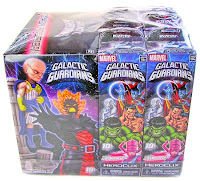
This formula is also altered in the significantly when the case is shifted to a Super Booster model. In this model 2 of the traditional 5 Figure Boosters are removed and replaced with a Super Booster that contains some type of Colossal character(s) (or a vehicle for the upcoming Batman set). You can usually expect to pull around 3 Super Rares, 8 Rares, 12 Uncommons, and 17 Commons, but again, if Chase figures are included, it is usually at the cost of a Rare figure. Surprisingly, you can still usually complete a CUR set if you buy a case in this model. The numbering on Colossals that have been released in Super Boosters as part of a set release have had their set numbers proceeded by a G and been in sequence from 01 to 07 (or less). Colossals release outside of this structure as Con Exclusives or prizes have been numbered more arbitrarily.
Next we’ll look at Starters, but specifically those that have been tied to a set release. In most cases, starting from the Fantastic Four starter which is considered part of Secret Invasion, these starters contain 6 or 7 characters, a double-sided map, objects, a PAC, and a Rulebook. The figures are usually numbered starting with 101 and going through 107 (or less) and share the same set icon with the set they are attached to. With Lord of the Rings, the starter numbers started at 201 instead, and the set had 8 figures as well as a multitude of Horde tokens and extra maps. The models in these sets may or may not show up in the set, but the dials are always different if they do.
The big exception to this rule is the Avengers Movie Starter which shares more with the Fast Force model than it does with the Starter model. So what’s the difference with the Fast Force model? First, a Fast Force does not come with a PAC or Rulebook. Second, the set icon is a modified version of the original set icon having a 6 superimposed around the original icon, and restarting the numbering a 001-006. The models in this set are ALWAYS found in some form in the original set that the new figures are based on. However, again they have different dials to work with. These sets are generally designed to play very well within themselves straight out of the box. They usually have point totals in 25 point increments that allow for ease of team building, some with multiple start lines to allow for more flexibility within the set for team building.
On to the Counter Top Display (CTD) model, which actually comes in at least 3 flavors (that I can think of)? The first is the Primer set. The Primer sets have become the official “preview” set for a major release. These sets are usually numbered 201-210 and share the same set icon with the set that they’re promoting. These sets usually highlight models of 10 popular characters within the set, and give alternate dials for each. Although in the most recent Chaos War primer, we actually got 3 characters that were variations (to the point of almost being like LEs of old) on characters in the set. Ultron doesn’t show up in the regular Chaos War set although the model does show up as one of his Drones. Vision (Jonas of the Young Avengers) could be considered a different character from the more traditional vision that shows up in the regular set. And Masque is a clone of Madam Masque that joined and sacrificed herself to save the Avengers, so she is in essence a different character as well. These sets have 10 figures with a flat rarity, so if you buy a CTD (which come 2 to a case) you will usually pull 2 full sets and 4 extra duplicates that usually are of 4 different characters. These sets are also wrapped in mini-bricks of 6 characters where all 6 characters are usually different. In theory you could get a full set with 2 extra figures from the purchase of 2 mini-bricks, but more than likely you’ll end up with 9 of the 10 and 3 dups, which leads most players to split a display with a friend, so that they can trade to each receive their full set.
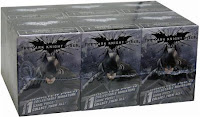
The second type of CTD are the Micro-Set releases like Street Fighter, Lord of the Rings, or The Dark Knight Rises that have between 20 and 30 characters with Rarities. Again these CTDs have 24 single-figure boosters wrapped in 4 mini-bricks of 6 boosters a piece (Street Fighter being the exception). In the mini-bricks you will usually pull 1 Rare (or Chase), 2 Uncommons, and 3 Commons (in Lord of the Rings 1 of every 4 mini-bricks lacked the Rare/Chase and instead had an additional Uncommon). With these sets I believe that you’re only “guaranteed” a CUR set if you buy both CTDs in a single case, and even then, I’ve never tried the theory myself. That said, you usually do quite well on buying 1 CTD, as you usually don’t pull many duplicates from a single display. I think I generally average around 3 dups when I buy one, although I’ve heard that The Dark Knight Rises was harsher. Like the Traditional Sets, these releases are usually numbered 001 to 030 (or less).
The third type of CTD are the Team Booster sets. Like the Super Booster sets for the Traditional releases, these sets have an additional larger booster packed in the brick. Unlike the Super Booster sets, this booster does not replace what would normally be pulled in a brick. In this configuration you still receive 6 single-figure boosters in addition to a Team Booster, which contains 3 figures of a given team packed together and ready to play. You’ll still usually pull 1 Rare (or Chase), 2 Uncommons, 3 Commons, and 3 Super Rares (at least that’s the tab color that they picked) which represent your team figures. So far we’ve only gotten the Avengers Movie set in this format, but personally I did quite well with my display, only missing 2 characters (1 Uncommon [Hulk] and 1 Rare [Iron Man]) from the CUR part of the set. Of course I also got lucky and pulled the two team packs I missed with the only other 2 I purchased. With these sets the numbering for the Team Pack figures were a continuation of the regular set.
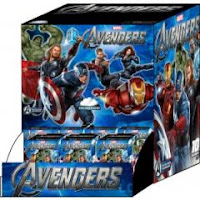
The last distribution type to cover is the Gravity Feed. These seem to be the most headache inducing of the distribution models, and part of that seems to be because WizKids hasn’t seemed to nail down a formula on these. Every time we think we have it figured out, WizKids does something different with it. This product is USUALLY a box that randomly shows up at Mass Market outlets like Target with no really set release date, and no good information on when or if they’ll actually be there. The displays can either be a 24 count or a 30 count box, and will usually be figures numbered 201 to 210. Like with the Primer CTD, if it’s a 24 count box, and if there are not chase figures, you can expect to get 2 sets of 10, and an additional 4 figures that usually don’t match each other, if you find a virgin box. That said, finding a virgin box is becoming increasingly difficult. Originally these figures showed up in single-figure boxes that some unscrupulous players would peak in and generally destroy if allowed. Then the Avengers Movie Set hit, with the Chase Loki, in those easy to peak boxes, and in a display of 30 figures, which would net you 2 sets, a Loki, and 9 extras if you could even find a virgin box anywhere. Now they’ve at least shifted these figures to foil packs so they’re harder to peak into, and more obvious if a player has. It doesn’t seem to have stopped the problem, but it’s at least a good show of effort on WizKids part. For these reasons, the Mass Market sets are the hardest 10 (or 11) figures to collect. And the real shame of it is that I really don’t think these products are opening the market to any new players (as WizKids would suggest they’re supposed to do). Instead they just frustrate the regular players that would gladly buy these items if they were more readily available.
Sorry to get off on such a tangent there. Anyway, I believe that covers most if not all of the distribution models on could run into with purchasable products. If you’ve read this article and still have questions (or notices something I missed) please feel free to include them in the comments.
The first product we’ll look at is the Standard Case of 5 Figure Boosters. This would be a case that has 20 Booster Packs split into 2 individual Wrapped Bricks of 10 Boosters. Traditionally, you can expect to pull about 3 Super Rares, 10 Rares, 15 Uncommons, and 22 Commons from 1 Brick. That number is of course thrown off by Chase figures. However, generally you can expect that if a chase figure is included in a Brick, it is USUALLY at the cost of a Rare figure. Usually you will pull a full CUR (Common, Uncommon, Rare) set if you buy an entire case. Obviously if you only buy a brick, the numbers are not in your favor to get a whole CUR set. That said, you will usually do quite well on the Commons and Uncommons. As for numbering, the CURSR figures are usually numbered sequentially as 001 through the number of figures in the set, which generally cap at 60 or less. Prior to The Brave and the Bold Chase figures were not numbered in sequence however since its release, they have been a continuation of the normal set numbering.
This formula is also altered in the significantly when the case is shifted to a Super Booster model. In this model 2 of the traditional 5 Figure Boosters are removed and replaced with a Super Booster that contains some type of Colossal character(s) (or a vehicle for the upcoming Batman set). You can usually expect to pull around 3 Super Rares, 8 Rares, 12 Uncommons, and 17 Commons, but again, if Chase figures are included, it is usually at the cost of a Rare figure. Surprisingly, you can still usually complete a CUR set if you buy a case in this model. The numbering on Colossals that have been released in Super Boosters as part of a set release have had their set numbers proceeded by a G and been in sequence from 01 to 07 (or less). Colossals release outside of this structure as Con Exclusives or prizes have been numbered more arbitrarily.
Next we’ll look at Starters, but specifically those that have been tied to a set release. In most cases, starting from the Fantastic Four starter which is considered part of Secret Invasion, these starters contain 6 or 7 characters, a double-sided map, objects, a PAC, and a Rulebook. The figures are usually numbered starting with 101 and going through 107 (or less) and share the same set icon with the set they are attached to. With Lord of the Rings, the starter numbers started at 201 instead, and the set had 8 figures as well as a multitude of Horde tokens and extra maps. The models in these sets may or may not show up in the set, but the dials are always different if they do.
The big exception to this rule is the Avengers Movie Starter which shares more with the Fast Force model than it does with the Starter model. So what’s the difference with the Fast Force model? First, a Fast Force does not come with a PAC or Rulebook. Second, the set icon is a modified version of the original set icon having a 6 superimposed around the original icon, and restarting the numbering a 001-006. The models in this set are ALWAYS found in some form in the original set that the new figures are based on. However, again they have different dials to work with. These sets are generally designed to play very well within themselves straight out of the box. They usually have point totals in 25 point increments that allow for ease of team building, some with multiple start lines to allow for more flexibility within the set for team building.
On to the Counter Top Display (CTD) model, which actually comes in at least 3 flavors (that I can think of)? The first is the Primer set. The Primer sets have become the official “preview” set for a major release. These sets are usually numbered 201-210 and share the same set icon with the set that they’re promoting. These sets usually highlight models of 10 popular characters within the set, and give alternate dials for each. Although in the most recent Chaos War primer, we actually got 3 characters that were variations (to the point of almost being like LEs of old) on characters in the set. Ultron doesn’t show up in the regular Chaos War set although the model does show up as one of his Drones. Vision (Jonas of the Young Avengers) could be considered a different character from the more traditional vision that shows up in the regular set. And Masque is a clone of Madam Masque that joined and sacrificed herself to save the Avengers, so she is in essence a different character as well. These sets have 10 figures with a flat rarity, so if you buy a CTD (which come 2 to a case) you will usually pull 2 full sets and 4 extra duplicates that usually are of 4 different characters. These sets are also wrapped in mini-bricks of 6 characters where all 6 characters are usually different. In theory you could get a full set with 2 extra figures from the purchase of 2 mini-bricks, but more than likely you’ll end up with 9 of the 10 and 3 dups, which leads most players to split a display with a friend, so that they can trade to each receive their full set.
The second type of CTD are the Micro-Set releases like Street Fighter, Lord of the Rings, or The Dark Knight Rises that have between 20 and 30 characters with Rarities. Again these CTDs have 24 single-figure boosters wrapped in 4 mini-bricks of 6 boosters a piece (Street Fighter being the exception). In the mini-bricks you will usually pull 1 Rare (or Chase), 2 Uncommons, and 3 Commons (in Lord of the Rings 1 of every 4 mini-bricks lacked the Rare/Chase and instead had an additional Uncommon). With these sets I believe that you’re only “guaranteed” a CUR set if you buy both CTDs in a single case, and even then, I’ve never tried the theory myself. That said, you usually do quite well on buying 1 CTD, as you usually don’t pull many duplicates from a single display. I think I generally average around 3 dups when I buy one, although I’ve heard that The Dark Knight Rises was harsher. Like the Traditional Sets, these releases are usually numbered 001 to 030 (or less).
The third type of CTD are the Team Booster sets. Like the Super Booster sets for the Traditional releases, these sets have an additional larger booster packed in the brick. Unlike the Super Booster sets, this booster does not replace what would normally be pulled in a brick. In this configuration you still receive 6 single-figure boosters in addition to a Team Booster, which contains 3 figures of a given team packed together and ready to play. You’ll still usually pull 1 Rare (or Chase), 2 Uncommons, 3 Commons, and 3 Super Rares (at least that’s the tab color that they picked) which represent your team figures. So far we’ve only gotten the Avengers Movie set in this format, but personally I did quite well with my display, only missing 2 characters (1 Uncommon [Hulk] and 1 Rare [Iron Man]) from the CUR part of the set. Of course I also got lucky and pulled the two team packs I missed with the only other 2 I purchased. With these sets the numbering for the Team Pack figures were a continuation of the regular set.
The last distribution type to cover is the Gravity Feed. These seem to be the most headache inducing of the distribution models, and part of that seems to be because WizKids hasn’t seemed to nail down a formula on these. Every time we think we have it figured out, WizKids does something different with it. This product is USUALLY a box that randomly shows up at Mass Market outlets like Target with no really set release date, and no good information on when or if they’ll actually be there. The displays can either be a 24 count or a 30 count box, and will usually be figures numbered 201 to 210. Like with the Primer CTD, if it’s a 24 count box, and if there are not chase figures, you can expect to get 2 sets of 10, and an additional 4 figures that usually don’t match each other, if you find a virgin box. That said, finding a virgin box is becoming increasingly difficult. Originally these figures showed up in single-figure boxes that some unscrupulous players would peak in and generally destroy if allowed. Then the Avengers Movie Set hit, with the Chase Loki, in those easy to peak boxes, and in a display of 30 figures, which would net you 2 sets, a Loki, and 9 extras if you could even find a virgin box anywhere. Now they’ve at least shifted these figures to foil packs so they’re harder to peak into, and more obvious if a player has. It doesn’t seem to have stopped the problem, but it’s at least a good show of effort on WizKids part. For these reasons, the Mass Market sets are the hardest 10 (or 11) figures to collect. And the real shame of it is that I really don’t think these products are opening the market to any new players (as WizKids would suggest they’re supposed to do). Instead they just frustrate the regular players that would gladly buy these items if they were more readily available.
Sorry to get off on such a tangent there. Anyway, I believe that covers most if not all of the distribution models on could run into with purchasable products. If you’ve read this article and still have questions (or notices something I missed) please feel free to include them in the comments.
Subscribe to:
Posts (Atom)